HSA3 – meta-acoustics made of metal
ABSORA's patented meta-acoustic metal HSA3 absorbs low frequencies with slim walls, causes little pressure drop and is non-combustible.
How it works
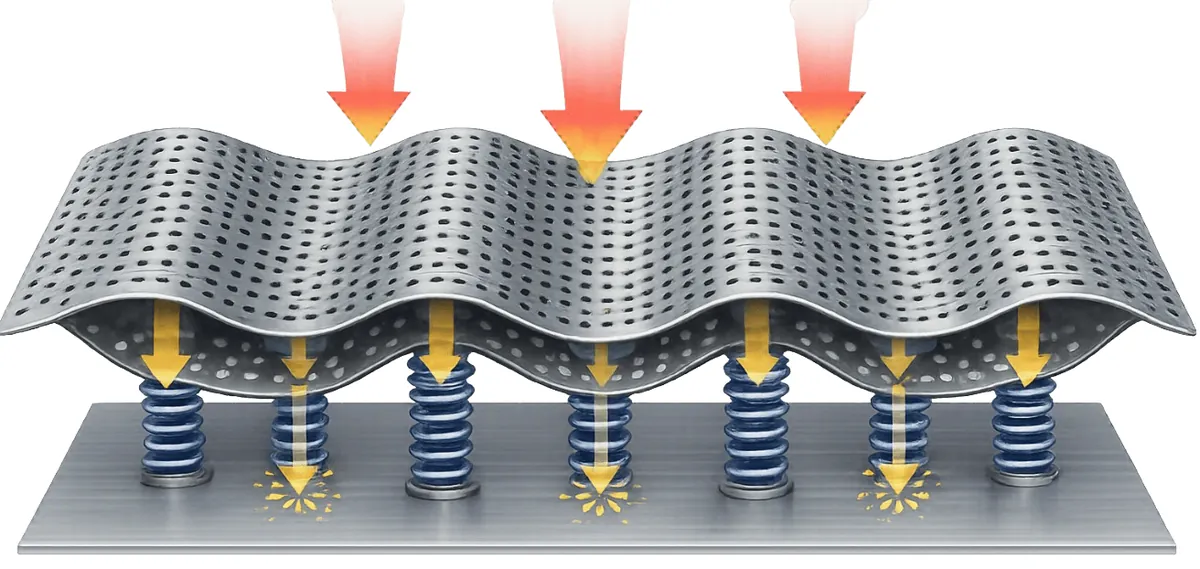
Micro-perforated metal and a resonance cavity act like many small spring-mass systems: sound energy is converted into heat. Conventional porous absorbers need a lot of thickness to do this at low frequencies – and therefore space and flow resistance.
For energy equipment this means: effective against transformer hum and fan noise, slim enclosures and hardly any effect on cooling.
HSA3 (0.3) with 100 mm mineral wool, to DIN EN ISO 354, frequency in Hz
Reverberation room TU Berlin, February 2026 (test report BeSB). The fibre-free version reaches up to 0.80 at 315 Hz, NRC 0.60–0.65.
What HSA3 delivers compared with splitter silencers.
Why low frequencies cost depth – and HSA3 does not.
A porous absorber such as mineral wool only works properly once it is about a quarter of a wavelength deep. That is where particle velocity peaks, and only there can the material create friction. At 100 Hz – the fundamental of a transformer – that is around 86 cm. Conventional enclosures solve this with thick walls and long splitter silencers. That costs space, weight and pressure drop.
HSA3 works on a different principle: as a resonant absorber. The micro-perforated, profiled metal and a defined air cavity behind it form a mass-spring system. The air in the perforations and the sheet act as the mass, the air cavity as the spring. Around resonance, sound energy is converted into heat by friction in the fine openings. The effect does not depend on thickness but on geometry.
In our enclosures HSA3 works with a 44 mm resonance cavity. It is tuned via:
- open area and perforation geometry of the sheet
- depth of the resonance cavity
- material and sheet thickness – aluminium or stainless steel
- backing: with mineral wool or fibre-free
| Frequency | Wavelength | λ/4 | Typical source |
|---|---|---|---|
| 63 Hz | 5.44 m | 1.36 m | engines, gensets |
| 100 Hz | 3.43 m | 0.86 m | transformer fundamental |
| 200 Hz | 1.72 m | 0.43 m | transformer harmonic, compressors |
| 500 Hz | 0.69 m | 0.17 m | fans |
| 1,000 Hz | 0.34 m | 0.09 m | fans, airflow |
For comparison: in the reverberation room HSA3 reaches an absorption coefficient of 0.99 at 200 Hz (test set-up see above).
Every energy installation sounds different.
For the design, the overall level is not enough – what matters is where in the spectrum the energy sits and whether it is tonal. Under German TA Lärm, tonal components receive a 3 or 6 dB penalty.
| Installation | Typical noise components | Approach |
|---|---|---|
| Transformer | Hum at 100 Hz (twice the mains frequency) and harmonics at 200 and 300 Hz, tonal | HSA3 wall build-up tuned to low frequencies; ventilation via tube silencers |
| Battery storage | Fans and air conditioners, broadband with blade tones, often at night | Enclosure with intake at the bottom and HSA3 tubes in the roof |
| PV inverters | High-frequency tonal components from the power electronics, plus fans | Closed shell with large, attenuated ventilation openings |
| Gensets, engines, CHP | Low-frequency firing and exhaust components, high sound power | Multi-stage: HSA3 walls, intake and exhaust silencers, exhaust muffler by others |
| Recycling, crushers | Broadband and impulsive | Enclosure or noise barrier with HSA3 absorber surface |
HSA3 tubes instead of conventional splitters.
Most energy installations need a lot of cooling air. The silencer therefore decides acoustics and efficiency at the same time.
- Round HSA3 tubes Ø 200 mm (Ø 280 mm on request) in staggered rows – the air flows past absorbing surfaces along the full length
- Half-shells on the side walls so that no unattenuated gap remains
- Designed for max. 5 m/s in the openings – no flow noise
- Free space above the fan so the exhaust air does not back up
- Pressure drop is checked against the available static pressure of the unit – up to 40 % lower than with splitter silencers
- For cabinets (BESS, inverters) as a tube field in the roof: intake at the bottom, exhaust at the top, no separate silencer
How we design an HSA3 enclosure.
Every enclosure is calculated before it is built – acoustically, aerodynamically and structurally.
- Unit dataSound power, airflow and available static pressure from the manufacturer's data sheet.
- Noise predictionLevel at the relevant receiver according to TA Lärm – with distance, reflection, tonality and background noise.
- Build-upWall build-up, tube field and silencer length – Standard approx. −15 dB(A), Premium approx. −20 dB(A), more on a project basis.
- Airflow and structureFlow and pressure drop with CFD, wind load according to the site's wind zone.
- Shop drawingsDrawings, BIM model and parts list – manufactured by ABSORA in Berlin.
One system. Every enclosure unique.
- Frame of MiniTec 45×45 profiles, anodised – structurally verified and prefabricated in the workshop
- Aluminium panels, powder-coated in any RAL colour
- HSA3 lining and HSA3 tubes for intake and exhaust
- Built without a floor and without contact with the unit, approx. 13 kg/m² envelope
Developed with ABSORA in Berlin.
Silent Engineering handles planning, acoustics and design. ABSORA GmbH, holder of the HSA3 patent, manufactures the enclosures in Berlin and installs them on site.
Your project doesn't fit a standard box?
We design every enclosure individually – you usually receive the quote within a few hours.