Quiet inverters – without losing output.
Acoustic enclosures from one modular kit, compatible with Huawei, SMA, Fox ESS and other makes. Configured in minutes, delivered as a pre-assembled kit.
HSA3 inner lining · aluminium, powder-coated · fire class A1 · made in Germany
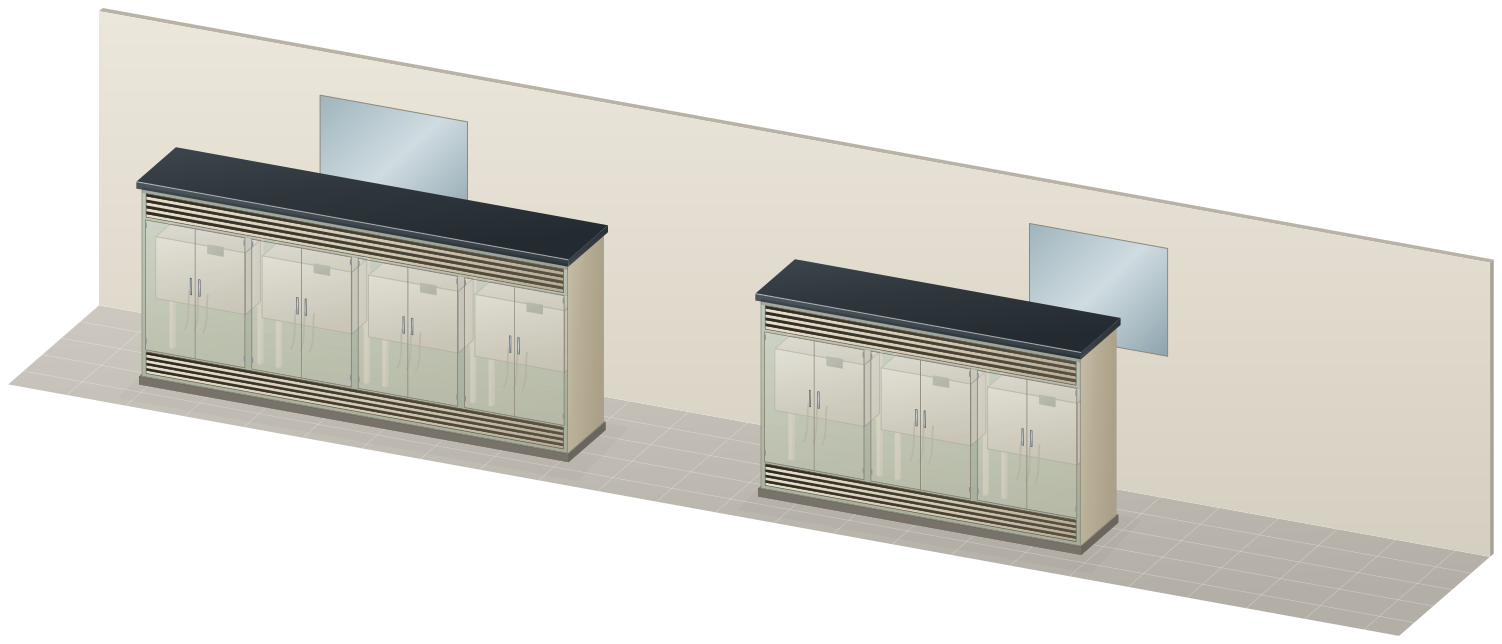
When the permit depends on noise
Inverters now stand where people live: on the façade of an apartment block, in a courtyard, at a school or a care home. As systems grow, so does fan power – and with it the noise.
More and more often the authority asks for a noise assessment (in Germany to TA Lärm), or neighbours complain. The date is set, the system is planned – and suddenly there is no solution.
On top of that comes the thin tone of the power electronics at 16–18 kHz. High frequencies travel directionally – closed panels and deflected openings without a direct line of sight screen them effectively.
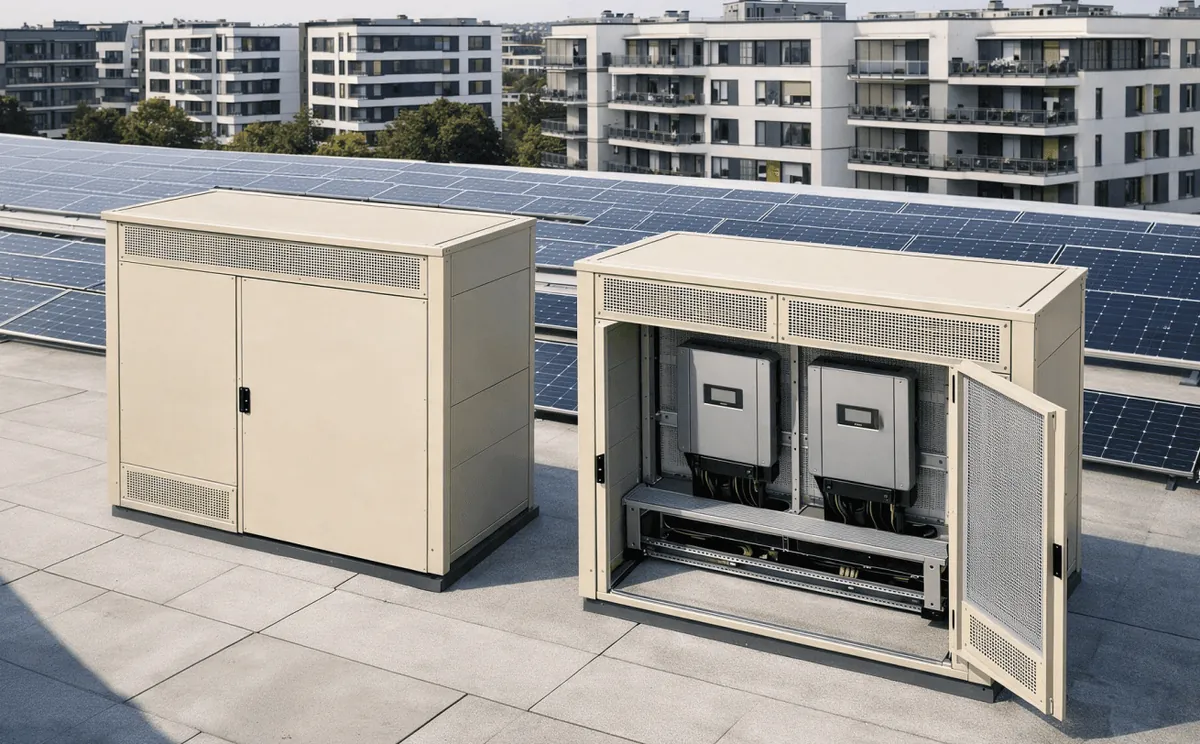
Quieter
Up to 22 dB insertion loss depending on version. The HSA3 inner lining also damps the low frequencies that carry furthest.
Cooling is maintained
Every configuration is thermally calculated before it can be ordered. Large ventilation areas instead of narrow openings.
Maintenance without dismantling
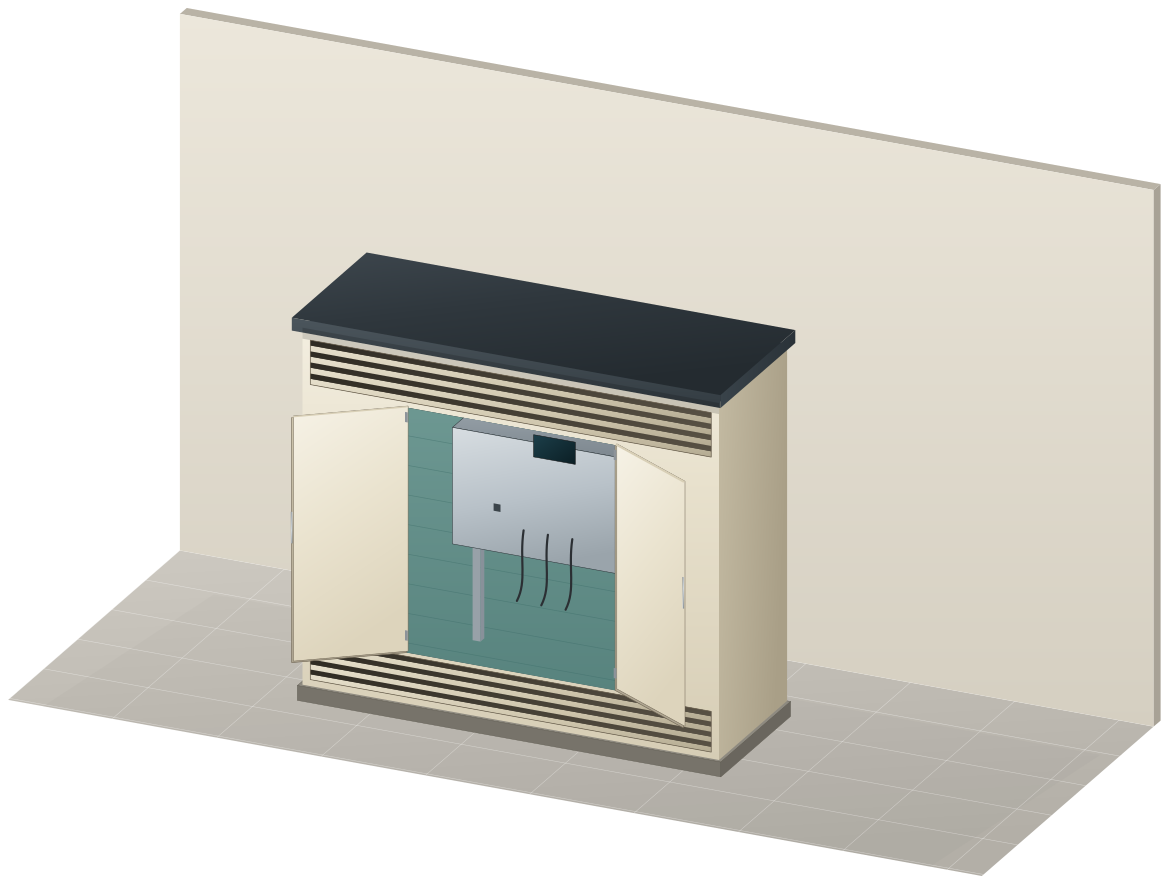
Each inverter sits behind its own lockable double door and hangs on a built-in mounting frame.
One design, six situations
All variants are built from the same kit. Only the base and the fixing differ.
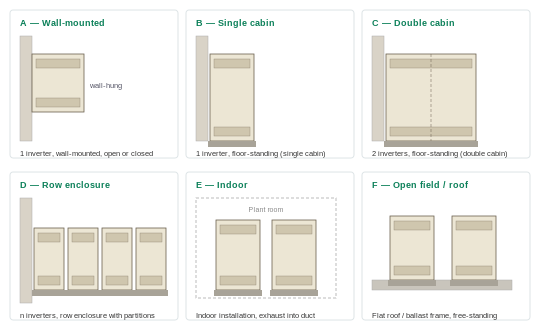
| Variant | Units | Fits when … |
|---|---|---|
| A · Wall-mounted | 1 | one unit hangs on the façade and there is no floor space |
| B · Single cabin | 1 | one unit should stand free in front of the wall, with no load on the masonry |
| C · Double cabin | 2 | two units stand side by side – cheaper than two single enclosures |
| D · Row enclosure | 3–6 | several units stand in a line; with partitions between the bays |
| E · Indoor | 1–6 | the plant room itself needs to be quieter; exhaust into a duct or room ventilation |
| F · Open field / flat roof | 1–6 | the units stand free and need attenuation on all sides |
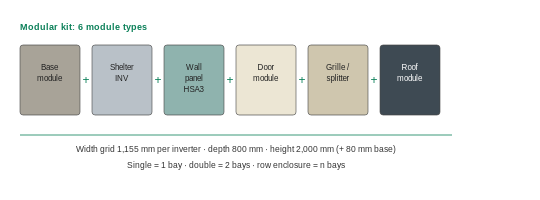
Six module types, one fixed width grid
A fixed width grid per inverter. Depth and height always stay the same, so roof, base, doors and ventilation modules are identical in every variant. That keeps production fast and the price predictable.
| Feature | Specification |
|---|---|
| Bay width per unit | 1,155 mm (special bay 1,500 mm for size class L) |
| Depth | 800 mm, the same for all variants |
| Height | 2,000 mm plus 80 mm base; wall version 1,270 mm |
| Frame | MiniTec 45 × 45, anodised |
| Panels | aluminium, powder-coated in any RAL colour; optionally seawater-resistant |
| Doors | double doors 2 × 600 mm per bay, lockable, with stay |
Three attenuation levels, one housing
You choose the level according to your noise situation. All three use the same frame and the same opening sizes – upgrading later is possible without rebuilding the housing.
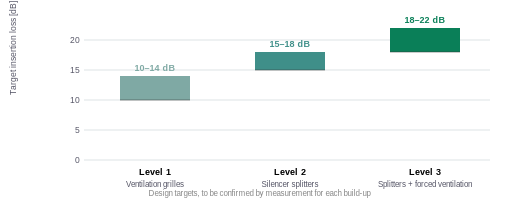
| Level | Version | Attenuation | Recommended when … |
|---|---|---|---|
| 1 | Ventilation grilles top and bottom across the full front width | 10–14 dB | the standard case: no power supply needed, lowest-cost version |
| 2 | HSA3 silencer splitters instead of grilles | 15–18 dB | the relevant receiver is close to or directly in front of the system |
| 3 | Splitters with thermostat-controlled EC fans | 18–22 dB | high requirements or high heat loss; 230 V supply required |
The values given are design values from our projects. For your specific situation we prepare a forecast taking distance, surroundings and receiver location into account.
What is inside the wall
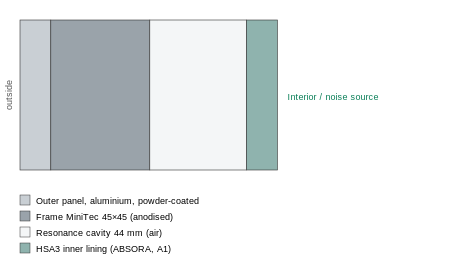
From outside to inside: aluminium panel, frame, resonance cavity, HSA3 inner lining. The slim build-up with a 44 mm resonance cavity delivers high absorption with low pressure drop – the decisive difference from thick conventional absorber build-ups.
Fire safety: HSA3 class A1, non-combustible.
Why cooling is maintained
The air is not moved by the enclosure but by the fans inside the inverter. Depending on the unit they deliver 800 to 1,300 m³/h – far more than is needed to remove the heat loss. The enclosure’s job is to let this airflow pass unhindered.
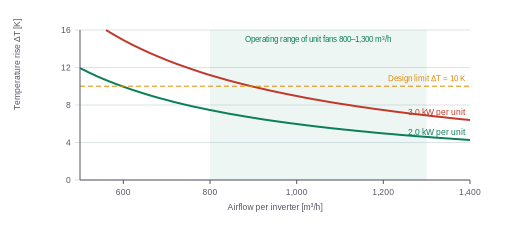
| Airflow per unit | Temperature rise at 2.0 kW | at 3.0 kW |
|---|---|---|
| 600 m³/h (calculated minimum) | 10.0 K | 14.9 K |
| 800 m³/h (lower fan output) | 7.5 K | 11.2 K |
| 1,000 m³/h | 6.0 K | 9.0 K |
| 1,300 m³/h (upper fan output) | 4.6 K | 6.9 K |
What matters is therefore not the air volume but the added resistance. We design the openings for at least 0.25 m² free area per unit and a maximum air velocity of 1.5 m/s. The pressure drop of the whole enclosure stays below 5 Pa – your unit’s fans barely notice it.
An extra benefit: the roof shields the unit from direct sun. In summer that is more often the cause of temperature derating than the enclosure itself.
Matched to your unit
We work with three size classes. You choose make and model; we adapt the mounting frame to the unit’s bracket and keep the minimum clearances from the installation manual.
| Class | Unit size (W × H × D) | Typical series | Bay width |
|---|---|---|---|
| S | up to 1,050 × 650 × 350 mm | Huawei SUN2000 lower power, SMA Sunny Tripower, Fronius, Kostal | 1,155 mm |
| M | up to 1,150 × 750 × 400 mm | Fox ESS R series, Huawei SUN2000 upper power classes, SMA Sunny Highpower, Sungrow, Kaco | 1,155 mm |
| L | up to 1,350 × 900 × 450 mm | Central and battery inverters of higher power | 1,500 mm |
Your unit is not listed? Send us the data sheet and we will add it.
The mounting frame
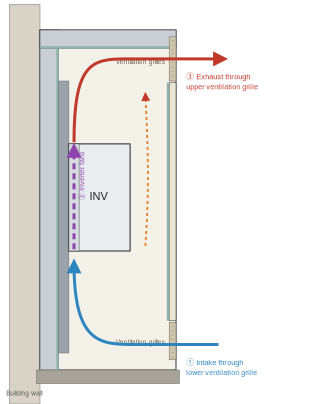
The inverter hangs on a frame of MiniTec profiles built into the enclosure, with a cable tray below.
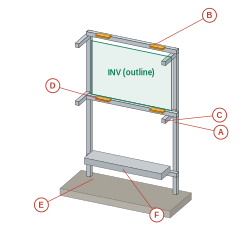
- AUprightMiniTec profile 45 × 45, anodised. Two per unit, carrying the full load.
- BCross membersThree: at the top, as the inverter support and as the cable tray carrier.
- CDepth strutStiffens the frame and ties it to the rear wall of the enclosure.
- DMounting railThe only part adapted per make: hole pattern and height to suit your unit’s wall bracket.
- EFoot bracketConnects to the enclosure base frame, adjustable for levelling.
- FCable trayPerforated, below the unit; carries AC, DC and data cables.
No fixing to the building wall is required – the enclosure is a complete, transportable unit. Load capacity is designed for at least four times the unit weight.
From configuration to installation
- ConfigureChoose unit, quantity, installation situation and attenuation level. The price appears instantly.
- Get the documentsDimension sheet, parts list, tender text and design data sheet as downloads.
- OrderProduced as a pre-assembled kit, prepared in modules at the factory.
- InstallAssembly by two people following the instructions – or by our installation service.
Ready for tender
Every configuration automatically delivers the documents you need for the bill of quantities. No back-and-forth, no waiting for a quote.
Dimension sheet
Front, side and top views with all connection dimensions and clearances.
Tender text
Ready-written specification item with material and design details.
Design data sheet
Acoustic and thermal design values, weight, fire classes.
Frequently asked questions about inverter enclosures
Does the inverter lose output because of the enclosure?
No, provided the enclosure is designed correctly. For every configuration we calculate heat loss, airflow and pressure drop. The openings are sized so that the internal temperature stays below the unit’s derating threshold. The roof also shields against direct sun, which causes derating more often than the enclosure does.
How much quieter does it really get?
Between 10 and 22 dB depending on version. How much of that reaches the neighbouring property depends on distance, surroundings and receiver location. Send us the situation and we will prepare a forecast.
Are there fixed prices?
Yes. The configurator’s PV catalogue lists enclosures with fixed prices for common inverters.
Is the manufacturer’s warranty retained?
We keep the minimum clearances and fixing methods required by the installation manual and document this. Please still clarify an enclosure with your equipment supplier in advance.
Can I upgrade later?
Yes. From level 1 to level 2 only the front module is replaced; housing and frame stay unchanged.
Does this also work for battery storage or charging infrastructure?
Yes, the same design. See the battery storage and charging stations pages or contact us – we check dimensions and heat loss.
What is HSA3?
An absorber system we use together with ABSORA. It achieves high absorption down to low frequencies with a slim build-up and is classified as fire class A1. More on the technology page.
What do you need for a quote?
Make and model, number of units, installation location and – if available – the distance to the nearest dwelling and the required limit. A site plan or photo helps.
Brand names and model designations are given solely to indicate compatibility and are the property of their respective manufacturers. No partnership with or approval by the manufacturers exists. Attenuation figures are design values; the project-specific forecast is decisive.
Describe your situation, get a forecast
Send us your site plan or a photo. You will receive an assessment with an indicative price and a noise forecast.